Source party
Share the original work
Submit author and contact details, documentation, code, data descriptions, data links where available, data sharing possibilities, and links to the related abstract, preprint, or paper.
OHBM Open Science SIG
A collaborative challenge connecting source and reproducing teams to strengthen transparent neuroimaging science.
The OHBM-OSSIG Reproducibility Challenge is a networking experience facilitated by the Open Science SIG, aiming at improving the reproducibility of scientific results.
Participants join forces in teams of two parties: a source party and a reproducing party. The source party provides a submitted OHBM abstract, procedures, code, and data when possible. The reproducing party independently re-runs or extends the analysis.
Source party
Submit author and contact details, documentation, code, data descriptions, data links where available, data sharing possibilities, and links to the related abstract, preprint, or paper.
Reproducing party
Register your expertise and interests, then either pick a source party or get matched by OSSIG at the Open Science Room. Once paired, you independently work through their documentation, code, and available data to reproduce their work.
Expected outcomes
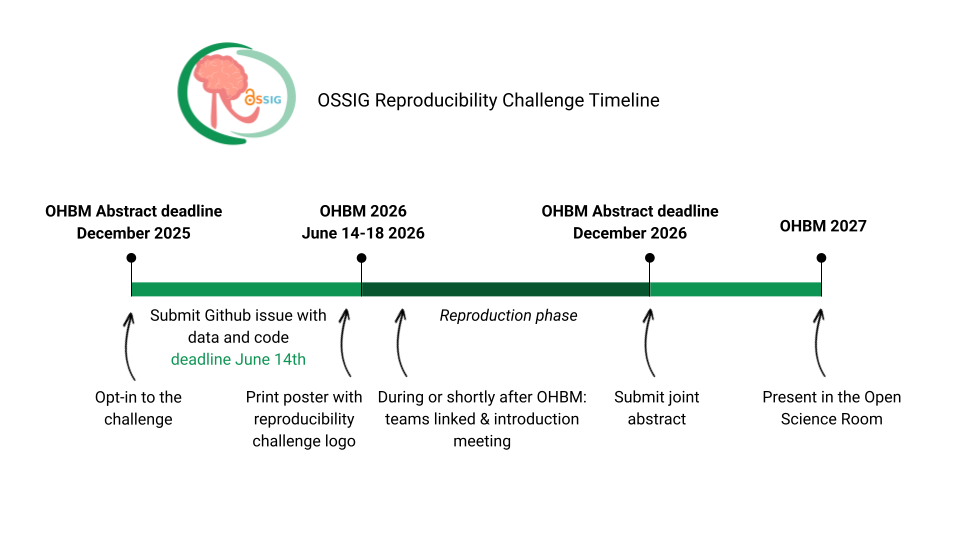
Once the reproduction is complete, teams jointly submit an abstract to OHBM 2027 and are invited to present in the Open Science Room. The effort is evaluated on how closely results matched, the openness of the source work, and any additional outputs. Reproducibility is hard, and well-documented attempts are valued regardless of the outcome.
The specific type of reproduction is determined by the availability of the original data.
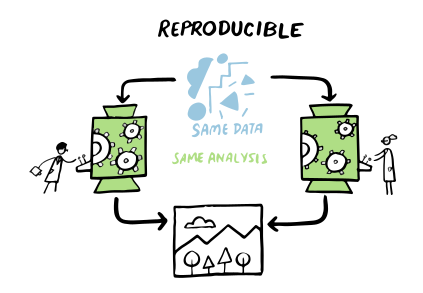
Running the same analysis on the same data.
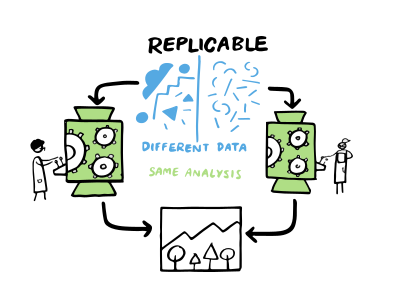
Running the same analysis on independent data.
Adapted from The Turing Way Community. Original illustration created by Scriberia with The Turing Way community, used under a CC-BY 4.0 licence. DOI: 10.5281/zenodo.3332807
Both source and reproducing parties register by opening an issue on the OSSIG GitHub page and selecting their role in the template.
Submit an OHBM 2026 abstract or register your reproduction expertise.
OSSIG supports team formation based on expertise and interests.
Teams may hold one brief introduction meeting to clarify scope and logistics.

Source parties complete their submission details (deadline June 14th). They are also invited to add a Reproducibility Challenge logo with a QR code to their poster, linking to the challenge website.
This signals to potential reproducing parties that the work is available for reproduction. Interested participants can scan the QR code to visit the challenge website and register. Team formation can take place during the poster sessions, the dedicated Open Science Room session, or at any other point during the conference.

How are the results evaluated...?
Outcomes are evaluated based on how closely replication matches the original work, the transparency and openness of the source work, and additional outputs such as software or publications.
Importantly, "unsuccessful" attempts do not reflect negatively; learning through the reproduction process is the main outcome :)
This challenge is inspired by the Reproducible Research Study Group of ISMRM.